Dwarf cichlids give you most of what makes cichlids fun, including bold color, real personality and visible parenting, in a much smaller fish. There’s no strict size cutoff: in the hobby, “dwarf cichlid” usually means a species that stays under about 4 inches. Tank needs vary widely, too. Some pairs fit a compact aquarium, while others need a 40-gallon footprint. The catch is that small doesn’t always mean easy: some of the most popular species need very clean, warm water. Here are five that are widely kept, with the conditions each one needs.
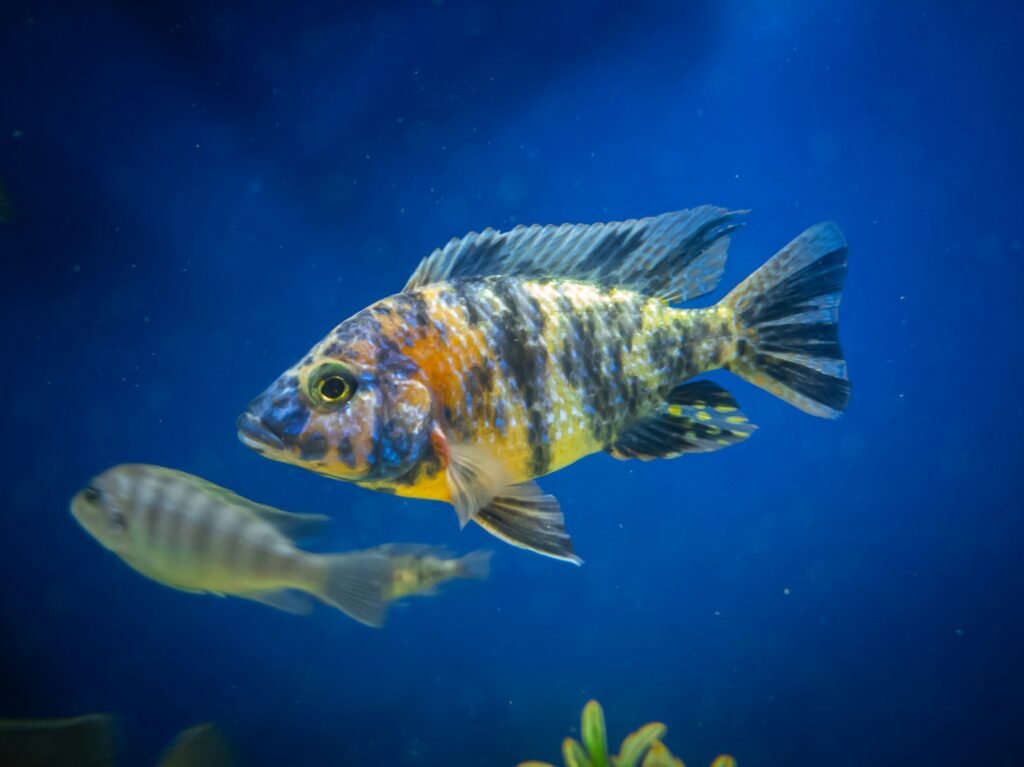
Dwarf Cichlids at a Glance
Sizes are standard length, measured without the tail.
| Species | Max size | Temperature | pH | Minimum tank for a pair | Difficulty |
|---|---|---|---|---|---|
| Bolivian ram | 3.1 in (80 mm) | 75–82°F | 6.0–7.5 | 36 × 18 in footprint | Beginner-friendly |
| Kribensis | 3.9 in (100 mm) | 75–81°F | 5.0–7.5 | 24 × 15 in footprint (about 19 gal) | Beginner-friendly |
| Cockatoo dwarf cichlid | Males 3 in, females 2 in | 72–84°F | 5.0–6.0 | 24 × 12 in footprint (about 14 gal) | Intermediate |
| Shell dweller (N. multifasciatus) | 1.8 in (45 mm) | 75–81°F | 7.5–9.0 | 18 × 12 in footprint (about 10 gal) | Intermediate |
| German blue ram | 1.6 in (40 mm) | 81–86°F | 4.0–7.0 | 24 × 12 in footprint (about 14 gal) | Advanced |
1. Bolivian Ram (Mikrogeophagus altispinosus)
If you’ve never kept a cichlid, start here. It’s a far more forgiving fish than its famous cousin, the German blue ram, and it handles a wider pH range and cooler water.
- Size: up to about 3.1 inches.
- Tank: a footprint of at least 36 × 18 inches for one fish or a pair, like a 40-gallon breeder. A group of six to eight needs a tank at least 4 feet long.
- Temperament: fairly sociable but a poor competitor for food, so avoid boisterous tankmates. Males can squabble in cramped tanks.
- Good to know: it sifts sand for food, so a soft sandy bottom suits it best.
2. Kribensis (Pelvicachromis pulcher)
Kribs are the classic beginner’s breeding cichlid: colorful, hardy and quick to pair off. Outside of breeding, they’re fairly shy and settle well into a community tank.
- Size: up to about 3.9 inches. Males are larger, and females develop a bright cherry-red belly.
- Tank: a 24 × 15 inch footprint, about 19 gallons, suits one pair. Give them caves, such as a coconut shell or a clay pot on its side.
- Temperament: peaceful most of the time, but both parents become very territorial when guarding eggs or fry. Bottom-dwellers in the same tank, like corydoras, may get chased.
- Good to know: a breeding pair can turn on each other. Watch closely after the fry become free-swimming, and keep a divider or spare tank on hand.
3. Cockatoo Dwarf Cichlid (Apistogramma cacatuoides)
The cockatoo is one of the most popular Apistogramma, and captive-bred fish can suit a peaceful community tank. Males have a tall, spiky dorsal fin and orange-and-red tail markings.
- Size: males up to about 3 inches, females about 2 inches.
- Tank: a 24 × 12 inch footprint (about 14 gallons) for a single pair, with caves, leaf litter and plants.
- Water: soft and acidic, around pH 5.0–6.0. Commercially bred fish are generally more adaptable; that acidic range matters most for breeding, especially with wild populations.
- Good to know: the female guards the eggs and fry. In a small tank she may get aggressive enough that the male needs to be moved out.
4. Shell Dweller (Neolamprologus multifasciatus)
“Multies” are among the smallest cichlids in the hobby and one of the most entertaining. They’re from Lake Tanganyika, live in empty snail shells, and form little colonies.
- Size: about 1.8 inches at most.
- Tank: an 18 × 12 inch footprint (about 10 gallons) works for a pair, and a colony needs more room.
- Water: hard and alkaline, pH 7.5–9.0. This is the opposite of most other dwarf cichlids here, so don’t mix them.
- Setup: provide more shells than fish, spaced apart to reduce aggression, and at least 2 inches of sand for digging. Buy more females than males.
5. German Blue Ram (Mikrogeophagus ramirezi)
The most striking dwarf cichlid is also the most demanding. Rams need warmer water than most community fish, and they need pristine water quality.
- Size: about 1.6 inches.
- Tank: a 24 × 12 inch footprint (about 14 gallons) for one pair. A breeding pair may claim about 2 feet of territory.
- Water: 81–86°F and soft, slightly acidic. Never add rams to a new tank. They need a fully cycled, mature aquarium.
- Good to know: rams aren’t a good fit for a general community tank. Keep tankmates calm and small, and skip other territorial cichlids.
Setting Up a Dwarf Cichlid Tank
- Floor space beats height. These are bottom-dwelling, territorial fish. A long, shallow tank gives each fish more ground. Our aquarium sizes guide lists common footprints.
- Caves and visual barriers. Rocks, wood, plants and caves let fish break line of sight, which cuts down on fights.
- Sand on the bottom. Rams sift it, multies dig in it, and most species spawn on or near it.
- Stable, clean water. Most dwarf cichlids react badly to ammonia and nitrite. Cycle the tank first and keep up regular water changes.
- Dither fish. A school of calm, mid-water fish can help shy cichlids feel safe enough to come out, as long as the tank has room and the water suits both.
- Test the water. Ammonia and nitrite should always read zero, and nitrate should stay low. Match the temperature of new water and use a dechlorinator, and avoid sudden swings in pH or hardness.
What Do Dwarf Cichlids Eat?
Diets vary by species, but most dwarf cichlids accept appropriately sized prepared foods. Offer a quality small sinking pellet or granule, plus frozen or live foods such as brine shrimp, daphnia and bloodworms. Feed small portions and make sure shy fish get their share before faster tankmates eat everything.
Good Tankmates for Dwarf Cichlids
Some South American dwarf cichlids, especially captive-bred cockatoo apistos and Bolivian rams, can live with small, peaceful schooling fish that suit the same water and won’t compete on the bottom. German blue rams are less suited to general community tanks. Examples include cardinal tetras (which also like warm water), rummy-nose tetras, pencilfish and hatchetfish. Avoid fin-nippers, large or aggressive fish, and other territorial cichlids in small tanks.
Shell dwellers need hard water, so pair them only with Tanganyikan species that suit the same conditions, or keep them on their own.
Frequently Asked Questions
How big do dwarf cichlids get?
Most stay between about 1.5 and 4 inches, depending on the species. Shell dwellers and German blue rams are at the small end. Kribensis and Bolivian rams are at the top.
Can dwarf cichlids live in a 10-gallon tank?
Only a few. A pair of shell dwellers (N. multifasciatus) fits an 18 × 12 inch footprint. Rams, apistos and kribs need more floor space, so a 20-gallon long or larger is a better starting point.
How many dwarf cichlids should be kept together?
It depends on the species and how many territories the tank offers. Rams, apistos and kribs are usually kept as a single pair in small and medium tanks, and some apisto keepers use one male with a few females in larger tanks with plenty of caves. Shell dwellers live in colonies, and Bolivian rams can be kept in a group if the tank is at least 4 feet long. Don’t assume any two fish will pair peacefully; watch closely and have a backup plan.
What fish can live with dwarf cichlids?
Small, peaceful schooling fish that like similar water are best, such as tetras, pencilfish and hatchetfish with South American species. Avoid other territorial cichlids, large fish and fin-nippers.
Which dwarf cichlid is easiest for beginners?
The Bolivian ram and the kribensis are the most forgiving. Both handle a wider range of water conditions than German blue rams or most apistos.
The Bottom Line
For a first dwarf cichlid, choose a Bolivian ram or a pair of kribs. If you have soft, acidic water and a planted tank, try cockatoo apistos. If your tap water is hard, shell dwellers in a sand-and-shell setup are a great fit. Leave German blue rams until you’re confident keeping warm, clean, stable water. Whichever you choose, give them floor space, hiding places and a fully cycled tank.

Dr. Johnson Coleman is a dedicated veterinary expert with over 10 years of hands-on experience in animal health and wellness. His mission is to help pets live longer, happier lives through compassionate care, practical guidance, and a genuine love for animals.
After earning his Doctor of Veterinary Medicine (DVM) degree, Dr. Coleman spent a decade working in both private clinics and community shelters, where he gained deep expertise in preventive medicine, pet nutrition, and behavioral care.
He believes that pet owners deserve reliable, easy-to-understand information about their companions’ health. Through his writing, Dr. Coleman breaks down complex veterinary topics into friendly, actionable advice that helps readers make informed decisions for their pets.
Outside of his professional work, Dr. Coleman volunteers with local animal rescue groups and enjoys spending time outdoors with his two golden retrievers. His lifelong dedication to animal welfare continues to inspire his work and connect with pet lovers around the world.