Cardinal Tetra Care Guide: Water Parameters, Tank Setup, Size, and Lifespan
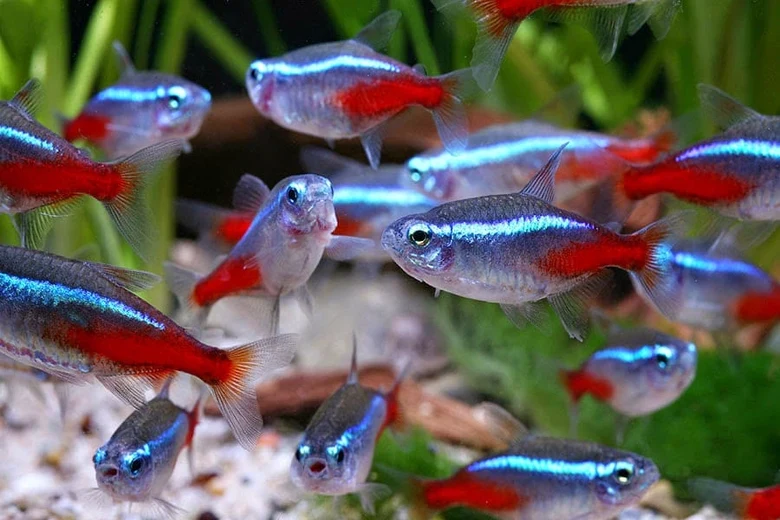
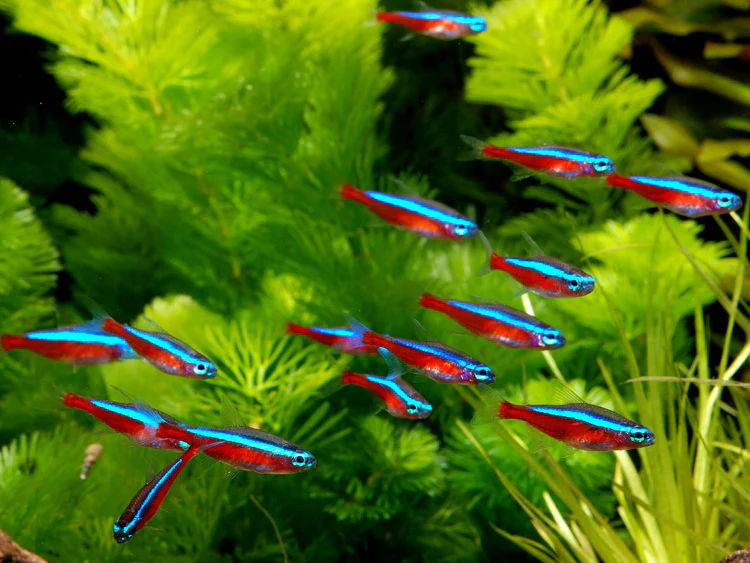
Cardinal Tetras are easy to mistake for Neon Tetras, especially in a busy fish-store tank. The two are similar enough that plenty of keepers never realize which one they actually have — and similar enough that generic “tetra care” advice glosses over where Cardinals genuinely differ. Here’s what’s actually specific to this fish: where it comes from, what it needs to thrive, and where the differences from a Neon actually matter. What Is a Cardinal Tetra? The Cardinal Tetra (Paracheirodon axelrodi) is a small freshwater shoaling fish from the Characidae family, native to the blackwater tributaries of the Rio Negro and upper Orinoco basins in Brazil, Colombia, and Venezuela. It’s easy to confuse with the Neon Tetra — more on that below — but the giveaway is the red stripe: on a Cardinal, it runs the entire length of the body, from the eye all the way to the tail, giving the fish a look of one continuous ribbon of red beneath an iridescent blue-green line. A significant proportion of the Cardinal Tetras sold in stores are still wild-caught, particularly fish originating from the Rio Negro region, though the species is also commercially bred on a large scale today (SeriouslyFish). The wild fishery has been studied since 1991 by Project Piaba, which found that the cardinal tetra makes up roughly 80% of the ornamental fish trade coming out of the Rio Negro region around Barcelos, Brazil. That income gives local communities a direct financial reason to keep the surrounding rainforest and rivers intact rather than clearing land for farming or logging — summed up by the project’s own line, “Buy a fish, save a tree.” Worth knowing: that conservation benefit applies specifically to wild-caught, Rio Negro–sourced fish, not to every Cardinal Tetra on the market — a captive-bred fish from an unrelated supplier doesn’t carry the same story. Cardinal Tetra vs. Neon Tetra: Telling Them Apart Since the confusion starts at the store, it’s worth settling it here before going further. The fastest visual tell is the red: on a Cardinal it runs the fish’s entire length, eye to tail; on a Neon it only covers the back half of the body. Particular Cardinal Tetra Neon Tetra Red stripe Full body length (eye to tail) Only back half of body Standard length About 1.4 in (3.5 cm) About 1.2 in (3 cm) Temperature 73–84°F (23–29°C) 70–77°F (21–25°C) Water sensitivity Wider tolerance than often assumed, but wild-caught stock prefers soft, acidic, stable water Also needs stable, cycled water; less commonly wild-caught Sourcing Significant proportion wild-caught (Rio Negro), plus large-scale commercial breeding Mostly farm-bred worldwide Both species should only be added to a fully cycled aquarium with stable water quality. Cardinal Tetras, especially wild-caught specimens, deserve particular attention to water chemistry and acclimation. If your tank is established and you want the more saturated color and a slightly bigger presence in a school, Cardinals are worth that step up in care — and the rest of this guide is about exactly what it involves. Cardinal Tetra Size and Lifespan Cardinal Tetras are small. SeriouslyFish lists an adult standard length of about 1.4 inches (3.5 cm), measured without the tail fin. Some aquarium references quote larger figures approaching 2 inches, which may reflect different measurement methods — total length rather than standard length — though not every source specifies which one it’s using. Either way, Cardinals run very slightly larger than Neon Tetras, though in a mixed school the difference is subtle. Lifespan is a case where a single clean number oversimplifies things. Cardinal Tetra lifespan varies substantially between wild and captive conditions. SeriouslyFish describes the species as virtually annual in nature, with individuals older than one year rarely encountered. Aquarium sources commonly report roughly 3 to 5 years in captivity, but that figure isn’t backed by one definitive study — it’s a convergence across many secondary sources rather than a single confirmed number that applies to every captive Cardinal Tetra. Cardinal Tetra Water Temperature and Parameters This is the section most people search for, and for good reason — water chemistry is where Cardinal Tetra care actually diverges from a lot of “easy” community fish. Parameter Range Temperature 73–84°F (23–29°C) pH 3.5–7.5 (wild-caught fish generally do best toward the acidic end) General hardness (GH) 1–12 dGH (softer water for wild-caught fish or breeding) Ammonia / nitrite 0 ppm, as with any established tank These figures reflect SeriouslyFish’s published aquarium range, which is wider than some care sheets suggest. That doesn’t mean any number in that range works equally well — wild-caught fish in particular do better toward the softer, more acidic end — but it does mean there’s no single “non-negotiable” number to chase. The bigger risk is instability: a tank that swings from 74°F to 80°F overnight because of a drafty room stresses Cardinals more than sitting steadily at 75°F. Avoid rapid changes in temperature or water chemistry in general. A reliable heater, thermometer, and routine water testing make it easier to maintain the stable conditions Cardinals actually need. Tank Setup and Tank Size Cardinal Tetras are a shoaling species that becomes visibly stressed, pale, and skittish in small groups. SeriouslyFish recommends a mixed-sex group of at least 8–10 specimens and a tank footprint of 60 × 30 cm (24 × 12 inches) or larger — roughly 14 US gallons at that footprint. A 20-gallon tank is a comfortable, slightly more generous starting point for a school that size. Skip the mental math of a fixed “gallons per fish” ratio beyond that — what actually matters is horizontal swimming room, stable water quality, and not adding more fish than your filter and maintenance routine can realistically support. Because they come from densely vegetated, tannin-stained blackwater streams, Cardinals feel most secure — and show their best color — in a tank that echoes that environment: One note on that last point: don’t rely on leaves or driftwood as a dependable way to soften or acidify your water — treat them as
Cardinal Tetra Care Guide: Water Parameters, Tank Setup, Size, and Lifespan Read Post »