Cardinal Tetras are easy to mistake for Neon Tetras, especially in a busy fish-store tank. The two are similar enough that plenty of keepers never realize which one they actually have — and similar enough that generic “tetra care” advice glosses over where Cardinals genuinely differ. Here’s what’s actually specific to this fish: where it comes from, what it needs to thrive, and where the differences from a Neon actually matter.
What Is a Cardinal Tetra?
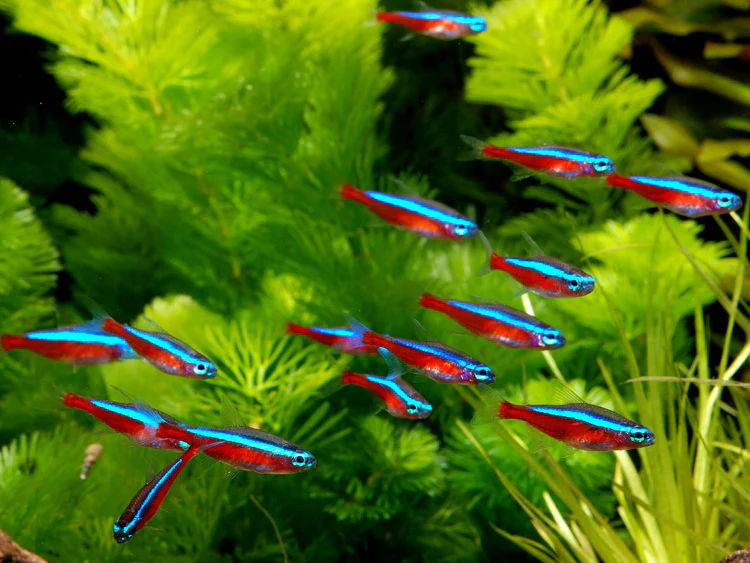
The Cardinal Tetra (Paracheirodon axelrodi) is a small freshwater shoaling fish from the Characidae family, native to the blackwater tributaries of the Rio Negro and upper Orinoco basins in Brazil, Colombia, and Venezuela. It’s easy to confuse with the Neon Tetra — more on that below — but the giveaway is the red stripe: on a Cardinal, it runs the entire length of the body, from the eye all the way to the tail, giving the fish a look of one continuous ribbon of red beneath an iridescent blue-green line.
A significant proportion of the Cardinal Tetras sold in stores are still wild-caught, particularly fish originating from the Rio Negro region, though the species is also commercially bred on a large scale today (SeriouslyFish). The wild fishery has been studied since 1991 by Project Piaba, which found that the cardinal tetra makes up roughly 80% of the ornamental fish trade coming out of the Rio Negro region around Barcelos, Brazil. That income gives local communities a direct financial reason to keep the surrounding rainforest and rivers intact rather than clearing land for farming or logging — summed up by the project’s own line, “Buy a fish, save a tree.” Worth knowing: that conservation benefit applies specifically to wild-caught, Rio Negro–sourced fish, not to every Cardinal Tetra on the market — a captive-bred fish from an unrelated supplier doesn’t carry the same story.
Cardinal Tetra vs. Neon Tetra: Telling Them Apart
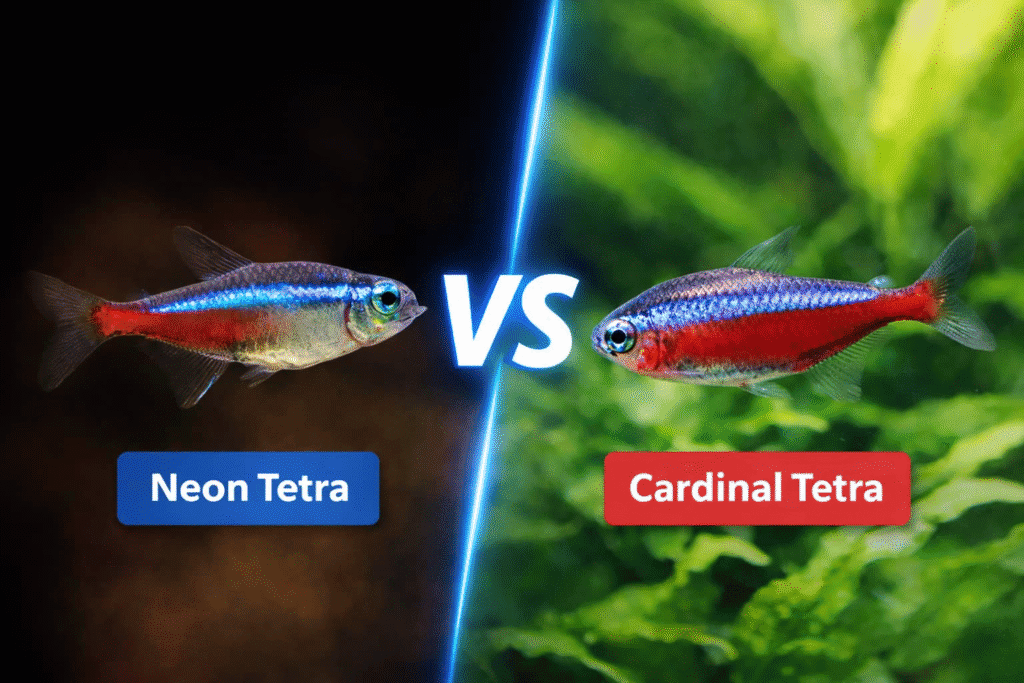
Since the confusion starts at the store, it’s worth settling it here before going further. The fastest visual tell is the red: on a Cardinal it runs the fish’s entire length, eye to tail; on a Neon it only covers the back half of the body.
| Particular | Cardinal Tetra | Neon Tetra |
| Red stripe | Full body length (eye to tail) | Only back half of body |
| Standard length | About 1.4 in (3.5 cm) | About 1.2 in (3 cm) |
| Temperature | 73–84°F (23–29°C) | 70–77°F (21–25°C) |
| Water sensitivity | Wider tolerance than often assumed, but wild-caught stock prefers soft, acidic, stable water | Also needs stable, cycled water; less commonly wild-caught |
| Sourcing | Significant proportion wild-caught (Rio Negro), plus large-scale commercial breeding | Mostly farm-bred worldwide |
Both species should only be added to a fully cycled aquarium with stable water quality. Cardinal Tetras, especially wild-caught specimens, deserve particular attention to water chemistry and acclimation. If your tank is established and you want the more saturated color and a slightly bigger presence in a school, Cardinals are worth that step up in care — and the rest of this guide is about exactly what it involves.
Cardinal Tetra Size and Lifespan
Cardinal Tetras are small. SeriouslyFish lists an adult standard length of about 1.4 inches (3.5 cm), measured without the tail fin. Some aquarium references quote larger figures approaching 2 inches, which may reflect different measurement methods — total length rather than standard length — though not every source specifies which one it’s using. Either way, Cardinals run very slightly larger than Neon Tetras, though in a mixed school the difference is subtle.
Lifespan is a case where a single clean number oversimplifies things. Cardinal Tetra lifespan varies substantially between wild and captive conditions. SeriouslyFish describes the species as virtually annual in nature, with individuals older than one year rarely encountered. Aquarium sources commonly report roughly 3 to 5 years in captivity, but that figure isn’t backed by one definitive study — it’s a convergence across many secondary sources rather than a single confirmed number that applies to every captive Cardinal Tetra.
Cardinal Tetra Water Temperature and Parameters
This is the section most people search for, and for good reason — water chemistry is where Cardinal Tetra care actually diverges from a lot of “easy” community fish.
| Parameter | Range |
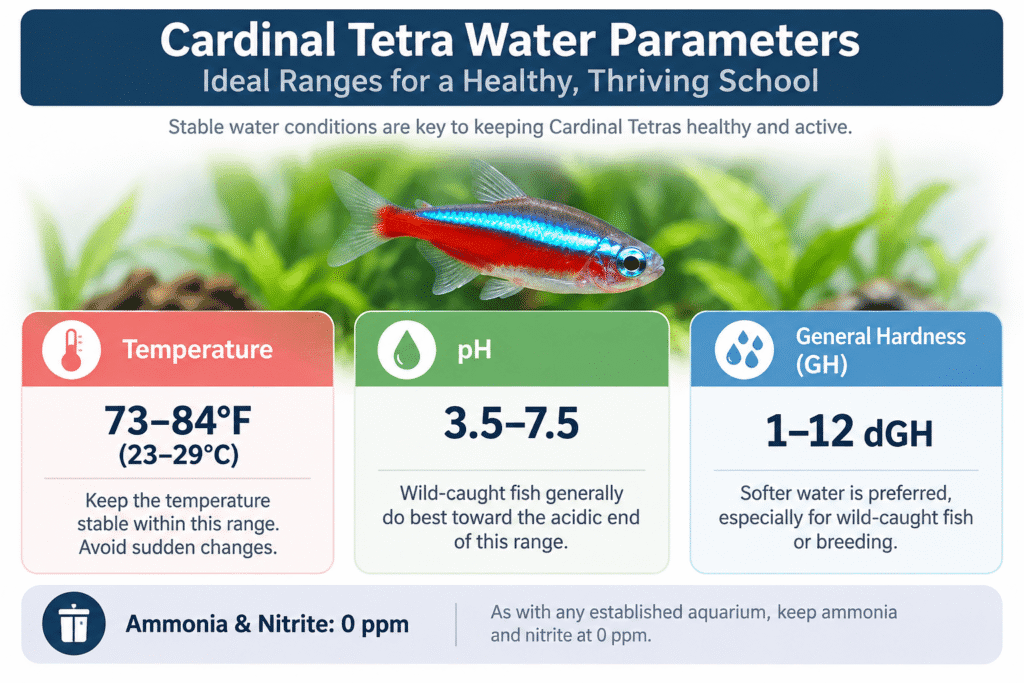
| Temperature | 73–84°F (23–29°C) |
| pH | 3.5–7.5 (wild-caught fish generally do best toward the acidic end) |
| General hardness (GH) | 1–12 dGH (softer water for wild-caught fish or breeding) |
| Ammonia / nitrite | 0 ppm, as with any established tank |
These figures reflect SeriouslyFish’s published aquarium range, which is wider than some care sheets suggest. That doesn’t mean any number in that range works equally well — wild-caught fish in particular do better toward the softer, more acidic end — but it does mean there’s no single “non-negotiable” number to chase. The bigger risk is instability: a tank that swings from 74°F to 80°F overnight because of a drafty room stresses Cardinals more than sitting steadily at 75°F. Avoid rapid changes in temperature or water chemistry in general. A reliable heater, thermometer, and routine water testing make it easier to maintain the stable conditions Cardinals actually need.
Tank Setup and Tank Size
Cardinal Tetras are a shoaling species that becomes visibly stressed, pale, and skittish in small groups. SeriouslyFish recommends a mixed-sex group of at least 8–10 specimens and a tank footprint of 60 × 30 cm (24 × 12 inches) or larger — roughly 14 US gallons at that footprint. A 20-gallon tank is a comfortable, slightly more generous starting point for a school that size. Skip the mental math of a fixed “gallons per fish” ratio beyond that — what actually matters is horizontal swimming room, stable water quality, and not adding more fish than your filter and maintenance routine can realistically support.
Because they come from densely vegetated, tannin-stained blackwater streams, Cardinals feel most secure — and show their best color — in a tank that echoes that environment:
- Soft, sandy or fine substrate
- Dense planting, especially at the sides and back, leaving open swimming space in the middle
- Subdued lighting; floating plants help diffuse harsh overhead light
- A gentle filter — Cardinals dislike strong, direct current
- Driftwood and aquarium-safe dried leaf litter, which can release tannins and humic substances for a natural blackwater look and a secondary microbial food source for fry
One note on that last point: don’t rely on leaves or driftwood as a dependable way to soften or acidify your water — treat them as a cosmetic and enrichment addition, not a water-chemistry tool. And skip natural peat specifically; its collection is unsustainable and environmentally destructive, and it isn’t necessary for healthy Cardinals.
Diet and Feeding
Cardinal Tetras are omnivorous with a strongly predatory lean in the wild. A peer-reviewed study of wild cardinal tetra stomach contents found that they predominantly consumed small animal prey associated with submerged litter, roots, and aquatic plants — microcrustaceans and chironomid (midge) larvae were the most common finds, while algae showed up relatively infrequently. That doesn’t mean you need to reproduce their wild diet exactly, but it does support offering varied, appropriately sized live or frozen foods — baby brine shrimp, daphnia, or micro-worms a few times a week — rather than relying on dry flake alone. Feed only what the school can finish in about two to three minutes to avoid excess waste fouling the water.
Common Cardinal Tetra Diseases: Recognition and Prevention
Because a significant proportion of Cardinal Tetras in the aquarium trade are wild-caught and may undergo a long supply chain before reaching a home aquarium, pay especially close attention to new arrivals and consider quarantining them in a separate tank before adding them to an established community.
Watch for these general warning signs rather than trying to self-diagnose from a single symptom:
- Small white, salt-grain-like spots on the body or fins, often with clamped fins and flashing against decor
- Grayish-white lesions, especially around the mouth, sometimes progressing quickly
- Ragged or disintegrating fin edges
- Loss of appetite, unusual hiding, rapid breathing, or abnormal swimming
- Sudden, dramatic loss of color
Several different aquarium diseases and environmental problems can produce very similar-looking symptoms, so the responsible next step is to check water parameters and identify the likely cause — not to medicate the whole tank based on appearance alone. Medications also vary by country and by what else lives in your aquarium (some treatments are unsafe for scaleless fish, snails, or shrimp), so if you’re not confident diagnosing the issue yourself, a local fish store or aquatic veterinarian is a better call than guessing.
Breeding Cardinal Tetras
Breeding Cardinals at home is possible, but it’s genuinely one of the harder projects in freshwater fishkeeping — a step up in difficulty from breeding Neons. Their specialized breeding requirements help explain why wild-caught fish continue to represent a significant part of the aquarium trade, even though Cardinal Tetras are also commercially bred. Per SeriouslyFish, a dedicated breeding tank generally needs:
- Soft, acidic water: pH 5.5–6.5, GH 1–5 dGH
- Temperature around 26.5–29°C (80–84°F)
- Very dim lighting, with fine-leaved plants such as java moss or spawning mops for the eggs to fall into
- Adults conditioned beforehand on live foods, then removed as soon as eggs are noticed — they will eat their own eggs given the chance
There’s no need for natural peat here either — humic substances from dried leaf litter or alder cones are considered a beneficial, more sustainable alternative. Eggs typically hatch in 24–36 hours, and fry need microscopic first foods like infusoria before graduating to microworm or brine shrimp nauplii. Even experienced breeders often see only partial survival from egg to juvenile, so treat a first attempt as a learning exercise rather than an expectation of a full batch of fry.
Frequently Asked Questions
What’s the right group size for Cardinal Tetras?
Aim for a mixed-sex group of at least 8–10. Cardinal Tetras are a shoaling species that looks and behaves more naturally in larger numbers, and a small group of just a couple of fish will be visibly more stressed and less colorful than a proper school.
How big do Cardinal Tetras get?
SeriouslyFish lists an adult standard length of about 1.4 inches (3.5 cm), measured without the tail fin. Some aquarium references quote larger figures approaching 2 inches, which may reflect a different measurement method (total length), though not every source specifies which one it’s using.
What temperature do Cardinal Tetras need?
Roughly 73–84°F (23–29°C), kept as stable as possible. There isn’t one single mandatory number — consistency matters at least as much as the exact figure you land on.
How long do Cardinal Tetras live?
Most care guides converge on roughly 3–5 years in captivity, though no single definitive study confirms one exact figure. Cardinal Tetra lifespan varies substantially between wild and captive conditions — SeriouslyFish describes the species as virtually annual in nature, with individuals older than one year rarely encountered, while aquarium sources commonly report several years in captivity.
Are Cardinal Tetras hard to keep?
They’re generally considered beginner-to-intermediate. The fish themselves aren’t fussy eaters or aggressive — the main skill is keeping water conditions stable rather than treating them as a fully “hardy, anything-goes” community fish.
The Bottom Line
Cardinal Tetras reward a bit of extra attention to water stability with one of the most striking schools you can keep in a freshwater tank. Keep the temperature steady, avoid extremes at either end of the pH and hardness range, and keep a proper-sized school, and you’re looking at years of vivid color rather than a slow decline. And if the fish you buy happens to be a wild-caught, Rio Negro–sourced Cardinal, you’re also — in a small way — supporting the same communities and forest that gave the hobby this fish in the first place.
The water parameters and figures above reflect the ranges most consistently reported by species-specific aquarium references at the time of writing; treat them as a starting point rather than a fixed rulebook, since your own tap water and tank conditions have the final say. If you’re keeping a wild-caught, Rio Negro–sourced Cardinal specifically, that’s also worth knowing — it’s the one detail that ties this fish’s care back to where it actually came from.

Dr. Johnson Coleman is a dedicated veterinary expert with over 10 years of hands-on experience in animal health and wellness. His mission is to help pets live longer, happier lives through compassionate care, practical guidance, and a genuine love for animals.
After earning his Doctor of Veterinary Medicine (DVM) degree, Dr. Coleman spent a decade working in both private clinics and community shelters, where he gained deep expertise in preventive medicine, pet nutrition, and behavioral care.
He believes that pet owners deserve reliable, easy-to-understand information about their companions’ health. Through his writing, Dr. Coleman breaks down complex veterinary topics into friendly, actionable advice that helps readers make informed decisions for their pets.
Outside of his professional work, Dr. Coleman volunteers with local animal rescue groups and enjoys spending time outdoors with his two golden retrievers. His lifelong dedication to animal welfare continues to inspire his work and connect with pet lovers around the world.