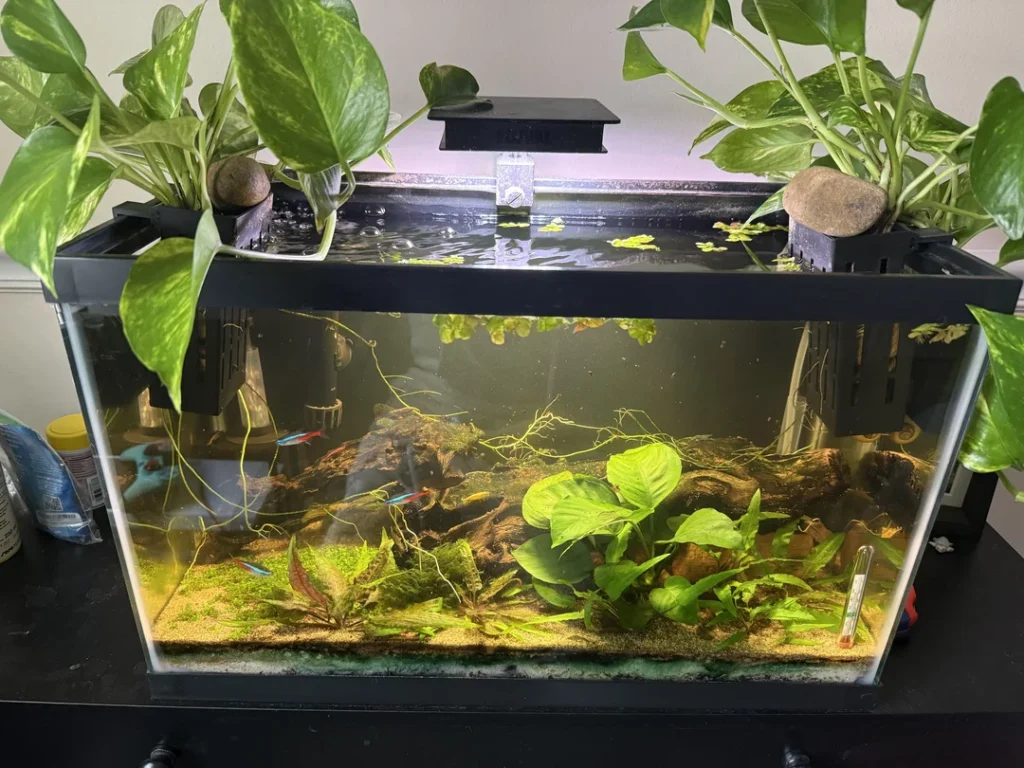
There is no single best planted tank substrate. The right choice depends on which plants you want to grow, what fish you keep, and how much setup work you’re willing to do. Nutrient-rich aquarium soil gives root-feeding plants the strongest start but changes your water chemistry and needs careful first weeks. Plain sand or gravel is cheaper, lasts indefinitely and grows plenty of plants once you add root tabs. Here’s how to decide.
The Quick Answer
- Growing demanding plants, carpets or stem plants, with soft-water fish or shrimp? Use an active aquarium soil.
- Growing easy rooted plants like Amazon swords and cryptocorynes? Fine gravel or coarse sand plus root tabs works well and costs less.
- Growing java fern or anubias? These grow attached to wood or rock, so the substrate barely matters. Keep their rhizomes uncovered.
- Keeping hard-water fish such as African cichlids or livebearers? Stick with an inert substrate, because soil pulls the water toward soft and acidic.
- Keeping fish that dig or sift, like corydoras or eartheaters? Sand is gentler on them, so pair it with root tabs.
Active Soil vs. Inert Substrate: What’s the Difference?
Planted tank substrates fall into two groups.
Active substrates, usually called aquasoil or aquarium soil, are baked granules of nutrient-rich soil. Their high cation exchange capacity (CEC) holds nutrients in the root zone where plants can reach them. Many also lower pH and KH, often keeping pH below 7, though the effect varies by product and by your tap water.
Inert substrates such as sand and plain gravel anchor roots but store little or no nutrients. They don’t change your water chemistry, and they last as long as the tank does.
| Feature | Aquarium soil (active) | Sand | Gravel |
|---|---|---|---|
| Nutrients | Built in, fades over time | None | None |
| Effect on water | Lowers pH and KH, softens water | Neutral (unless it’s crushed coral or aragonite) | Neutral (unless it contains limestone) |
| First weeks | Can release ammonia; needs big water changes | Rinse and go | Rinse and go |
| Lifespan | Years, but the nutrient boost fades and granules can break down | Indefinite | Indefinite |
| Best plants | Carpets, stem plants, demanding species | Swords, crypts, vallisneria with root tabs | Swords, crypts with root tabs |
| Best fish | Soft-water fish and shrimp that suit the resulting pH and hardness, once the tank is fully cycled | Corydoras, loaches, diggers | Most community fish |
| Cost | Highest | Low | Low |
1. Aquarium Soil: Best for Demanding Plants
If you want a dense carpet, fussy stem plants or a high-tech tank with CO2, aquarium soil is the usual choice. The nutrients are already where the roots are, so plants root in fast and grow evenly.
The trade-offs are real, though:
- Ammonia in the first weeks. Some soils can push ammonia above 10 ppm within days of setup. Plan on frequent large water changes for the first few weeks, and don’t add fish or shrimp until the tank is fully cycled and ammonia and nitrite consistently test at zero. Our guide to cycling a freshwater tank explains how to tell when it’s safe.
- Softer, more acidic water. That suits tetras, rasboras, many dwarf cichlids and caridina shrimp, but not fish that need hard, alkaline water.
- It doesn’t last forever. The buffering and nutrient boost fade, sometimes within months in a fast-growing tank. You can top up with root tabs. Lower-quality soils can also turn mushy and compact over time.
- It’s messy to replant. Pulling plants out of soil clouds the water. Some keepers add a thin cap of coarse sand on top to help hold it in place.
2. Sand: Best for Bottom-Dwellers and Natural-Looking Tanks
Sand is the gentlest substrate for fish that forage with their mouths or barbels, such as corydoras catfish. It looks natural and is easy to keep tidy with a gravel vacuum held just above the surface. See our guide on cleaning aquarium sand.
For plants, choose a coarser grain. Grains of about 1–3 mm are ideal. Very fine sand packs down tightly, which makes it harder for roots to spread. Push root tabs under heavy root feeders and dose a liquid fertilizer for everything else.
3. Gravel: Cheapest and Easiest
Plain aquarium gravel is the low-cost, low-fuss option. Regular gravel works well even with Amazon swords and other root-feeding plants, as long as you keep it fertilized with root tabs.
Grain size matters here too. Small, rounded gravel is better than chunky pea gravel, which leaves gaps too big for fine roots to grip. Gravel also traps more debris than sand, so vacuum it during water changes.
4. Mixed and Layered Setups
You don’t have to pick only one. Common combinations include:
- Soil in the planted area, sand in the foreground. Good for tanks with corydoras or an open swimming area.
- Soil capped with a thin layer of sand. Keeps the soil from clouding the water when you replant.
- Inert gravel with root tabs under specific plants. The budget approach, which suits most low-tech tanks.
Which Plants Actually Need a Rich Substrate?
Not every plant feeds through its roots, so the substrate matters more for some than others.
- Root feeders: Amazon swords, cryptocorynes, vallisneria and dwarf sagittaria take most of their nutrients from the substrate. Use soil or root tabs.
- Carpeting plants: Species like dwarf hairgrass and Monte Carlo grow best in soil with good light.
- Stem plants: Most absorb nutrients from the water as well as the roots, so liquid fertilizer does much of the work.
- Epiphytes: Java fern, anubias and bucephalandra should be tied to wood or rock, not buried. Burying the rhizome can make it rot, so these grow on any substrate.
How Deep Should Planted Tank Substrate Be?
As a rough guide:
- Carpeting plants: about 1 inch (2–3 cm).
- Medium plants: at least 2 inches (5 cm), with 3 inches (8 cm) or more better.
- Large crypts and swords: about 4 inches (10 cm) or more.
Sloping the substrate so it’s deeper at the back gives tall plants more root room and makes the tank look deeper. To work out how much substrate to buy for your tank’s footprint, check its dimensions in our aquarium sizes guide.
How to Set Up a Planted Substrate
- Rinse inert substrates. Rinse sand and gravel in a bucket until the water runs mostly clear. Most aquarium soils should not be rinsed, so follow the bag’s directions.
- Build the slope. Shallow at the front, deeper at the back.
- Fill slowly. Pour water onto a plate or plastic bag so it doesn’t blast a crater in the substrate.
- Plant, then add root tabs. With an inert substrate, push root tabs deep into the substrate near heavy root feeders, following the product’s directions.
- Cycle before adding animals. With soil, keep up large water changes and test ammonia before adding any fish.
Frequently Asked Questions
What is a good, cheap substrate for a planted aquarium?
Plain aquarium gravel or coarse sand with root tabs is the cheapest option that works. It grows easy root feeders like swords and crypts well, and you can add liquid fertilizer for stem plants.
Which is better for planted aquariums, sand or gravel?
Both work when you add root tabs. Coarse sand is better if you keep bottom-dwellers like corydoras. Small gravel holds plants in place well and is easy to rinse. Avoid very fine sand, which compacts, and chunky gravel, which leaves gaps fine roots can’t hold.
What should I put at the bottom of a fish tank for plants?
Use aquarium soil for nutrient-hungry rooted plants, or aquarium-safe sand or gravel with root tabs for an affordable planted tank. Don’t use bagged garden soil or potting mix on its own; it can cloud the water and release nutrients and ammonia unless it’s set up as a properly capped soil layer.
Do I need aquarium soil to grow plants?
No. Many popular plants grow well in inert substrates. Java fern and anubias don’t need any substrate at all, and swords and crypts do fine in gravel with root tabs. Soil is most useful for carpets and demanding plants.
How often should I add root tabs?
Follow the product’s directions. Many keepers replace them every few months, placing them near the roots of heavy feeders. In aquarium soil, root tabs can also top up nutrients as the soil ages.
Can I put aquarium soil in a tank with fish already in it?
It’s risky. Fresh soil can release ammonia and will change your pH and hardness, which can stress fish. If you’re switching substrates, keep the fish in a separate, established aquarium until the new setup is fully cycled, ammonia and nitrite consistently test at zero, and pH, GH and KH suit the species.
The Bottom Line
Choose aquarium soil if you’re growing demanding plants in soft water and can handle a few weeks of heavy water changes. Choose sand or gravel with root tabs if you’re growing easy plants, keeping hard-water or bottom-dwelling fish, or want to spend less. Either can give you a healthy planted tank. The plants you pick matter more than the bag you buy.

Dr. Johnson Coleman is a dedicated veterinary expert with over 10 years of hands-on experience in animal health and wellness. His mission is to help pets live longer, happier lives through compassionate care, practical guidance, and a genuine love for animals.
After earning his Doctor of Veterinary Medicine (DVM) degree, Dr. Coleman spent a decade working in both private clinics and community shelters, where he gained deep expertise in preventive medicine, pet nutrition, and behavioral care.
He believes that pet owners deserve reliable, easy-to-understand information about their companions’ health. Through his writing, Dr. Coleman breaks down complex veterinary topics into friendly, actionable advice that helps readers make informed decisions for their pets.
Outside of his professional work, Dr. Coleman volunteers with local animal rescue groups and enjoys spending time outdoors with his two golden retrievers. His lifelong dedication to animal welfare continues to inspire his work and connect with pet lovers around the world.