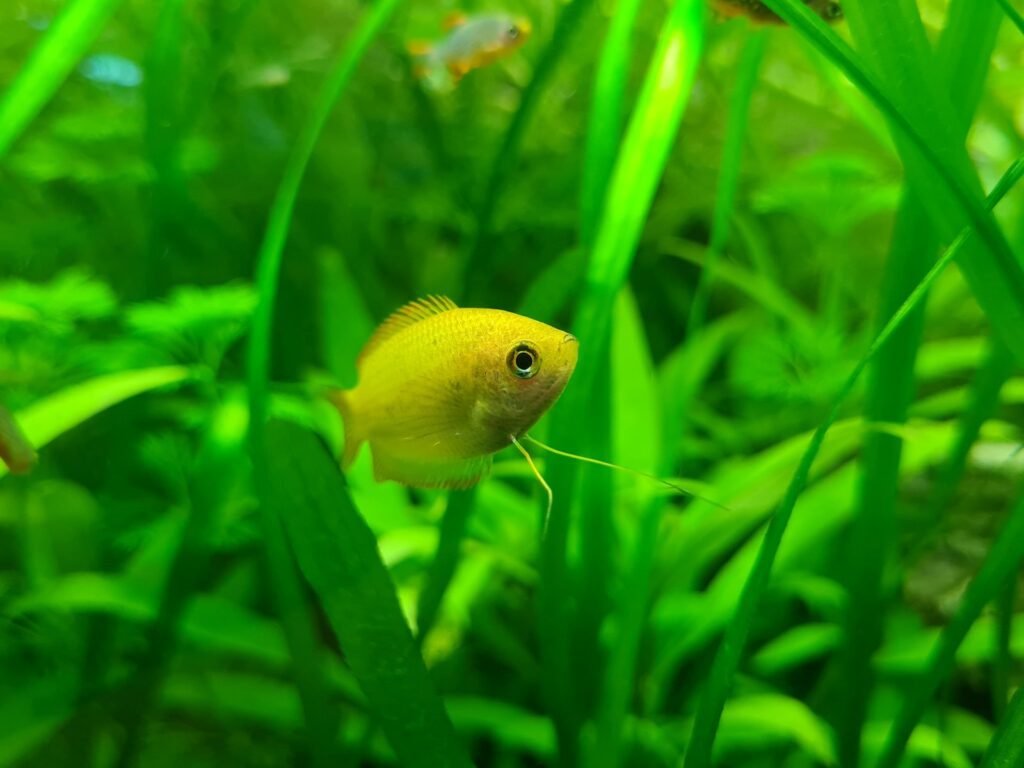
The honey gourami (Trichogaster chuna) is a small, calm gourami that makes a peaceful centerpiece for a community tank. Breeding males glow bright orange with a dark throat, and like all gouramis, it can breathe air from the surface. It’s one of the gentlest gouramis available. The main things to get right are calm tankmates, a covered tank and a varied diet. This guide is part of our list of 25 small fish for freshwater aquariums.
Honey Gourami Quick Facts
| Trait | Honey gourami |
|---|---|
| Scientific name | Trichogaster chuna |
| Adult size | About 2.2 in (55 mm) standard length |
| Temperature | 72–81°F (22–27°C) |
| pH | 6.0–7.5 |
| Hardness | 2–15 dGH |
| Minimum tank footprint | 24 × 12 in (60 × 30 cm), about 54 liters (14 gallons), for a pair or small group |
| Group size | A pair, or a small group of 4–6 in a larger tank |
| Temperament | Peaceful, slow, easily outcompeted |
Where Honey Gouramis Come From
Honey gouramis live in slow, heavily vegetated waters such as ponds, ditches and flooded fields in the Ganges and Brahmaputra river systems of India and Bangladesh, with records from Nepal. That explains their love of calm water and lots of plants.
Tank Setup
- Tank size: a footprint of at least 24 × 12 inches for a pair or small group, like a 20-gallon long.
- Plants and floating cover: dense planting and floating plants make them feel secure and give males a place to build bubble nests.
- Gentle flow: strong current stresses them. Use a sponge filter or a baffled outflow.
- Tight lid and air gap: honey gouramis have a labyrinth organ that lets them breathe air at the surface. Use a tight-fitting lid with an air space under it. The lid also stops them from jumping.
- Cycled tank: add them only once the tank is fully cycled. See our cycling guide.
Feeding Honey Gouramis
Honey gouramis accept dry foods and benefit from regular live or frozen foods alongside a varied, complete prepared diet. Offer:
- A quality small flake or micro pellet
- Frozen or live daphnia, brine shrimp and bloodworms
Because they’re slow, they can lose out at feeding time. Watch to make sure they get their share, especially with faster fish in the tank.
How Many Honey Gouramis Should Be Kept Together?
Keepers do well with either a pair or a small group of 4–6, though groups form a pecking order. Honey gouramis are social but don’t school. A compatible pair can live in a well-planted 20-gallon long, but separate them if one keeps chasing the other. A group of 4–6 needs more space, more plants as visual barriers and closer monitoring.
Best Tank Mates for Honey Gouramis
Choose calm fish that won’t outcompete them or nip at them, such as:
- Peaceful schooling fish like rasboras and small tetras, for example neon tetras and ember tetras
- Kuhli loaches and other less active bottom-dwellers
- Corydoras. Our corydoras guide lists peaceful options.
Check each species’ temperature, water and group-size needs before combining them; even peaceful fish can outcompete a slow gourami at feeding time. Avoid territorial or aggressive fish, fin-nippers, and larger gouramis.
Honey Gourami vs. Thick-Lipped Gourami
Fish sold as “sunset” or “red” honey gouramis aren’t always true honey gouramis. Selectively bred red, sunset and golden strains of the honey gourami exist, but so does a sunset strain of the thick-lipped gourami (Trichogaster labiosa), which grows to about 3.9 inches. The two look similar as juveniles, so check the scientific name, Trichogaster chuna, before buying.
Males vs. Females
Females are brownish, slightly larger and have a broad brown stripe along the side. Males in breeding color turn bright orange on the body and gill cover, with a dark blue to black head and throat. These differences are clearest in wild-type fish; selectively bred color varieties can be harder to sex by appearance alone.
Breeding Honey Gouramis
Honey gouramis are bubble-nesters. The male builds a nest, often under a broad leaf or in a corner, and courts the female. Eggs hatch in about 24–36 hours, and fry become free-swimming 24–48 hours later. The fry need infusoria or liquid fry food for their first week. A guarding male may chase other fish away from the nest, so provide hiding places and separate fish if the chasing doesn’t stop. In a dedicated breeding tank, many keepers move the female out after spawning and the male once the fry are free-swimming, and protect the fry from filter intakes and sudden water changes.
Frequently Asked Questions
How many honey gouramis should be kept together?
A compatible pair can live in a planted 20-gallon long, but watch for persistent chasing. A small group of 4–6 can work in a larger, well-planted tank.
What fish pair well with honey gouramis?
Calm schooling fish such as rasboras and small tetras, plus peaceful bottom-dwellers like kuhli loaches and corydoras.
Are honey gouramis hard to keep alive?
They’re generally manageable for beginners who keep the water stable. They get stressed by aggressive tankmates, strong current or losing out at feeding time, so a cycled, planted tank, calm companions and regular water testing are essential.
How big does a honey gourami get?
About 2.2 inches (55 mm) standard length, measured without the tail.
Can a honey gourami live with a betta?
It’s risky. Both are labyrinth fish that use the surface, and bettas can be territorial. Most keepers avoid the combination.
The Bottom Line
Honey gouramis are a peaceful, colorful centerpiece for a calm community tank. Give them a covered tank with an air gap, gentle flow, plenty of plants and calm tankmates, and feed live or frozen foods alongside dry food. For more small fish, see our full list of small freshwater fish.

Dr. Johnson Coleman is a dedicated veterinary expert with over 10 years of hands-on experience in animal health and wellness. His mission is to help pets live longer, happier lives through compassionate care, practical guidance, and a genuine love for animals.
After earning his Doctor of Veterinary Medicine (DVM) degree, Dr. Coleman spent a decade working in both private clinics and community shelters, where he gained deep expertise in preventive medicine, pet nutrition, and behavioral care.
He believes that pet owners deserve reliable, easy-to-understand information about their companions’ health. Through his writing, Dr. Coleman breaks down complex veterinary topics into friendly, actionable advice that helps readers make informed decisions for their pets.
Outside of his professional work, Dr. Coleman volunteers with local animal rescue groups and enjoys spending time outdoors with his two golden retrievers. His lifelong dedication to animal welfare continues to inspire his work and connect with pet lovers around the world.