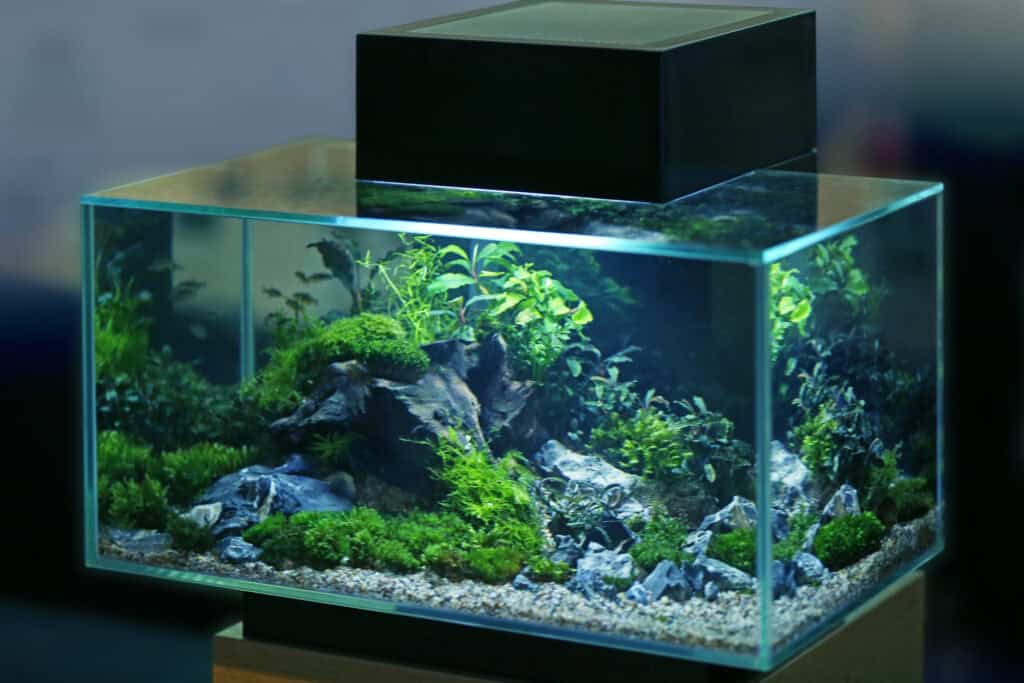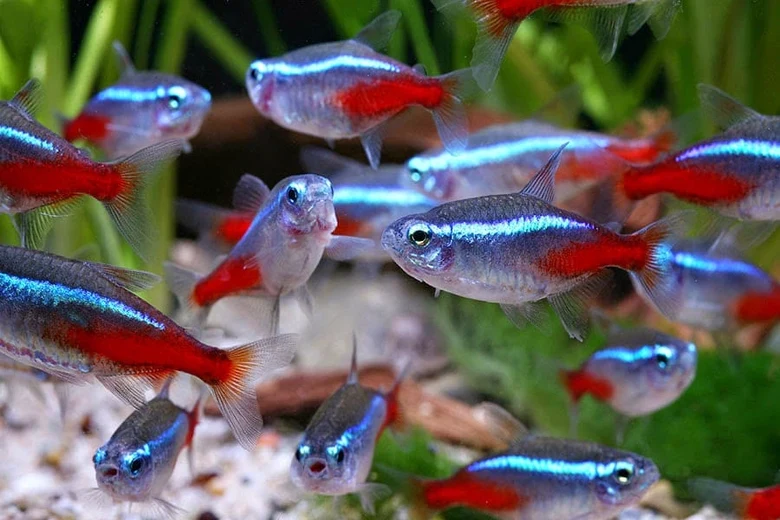
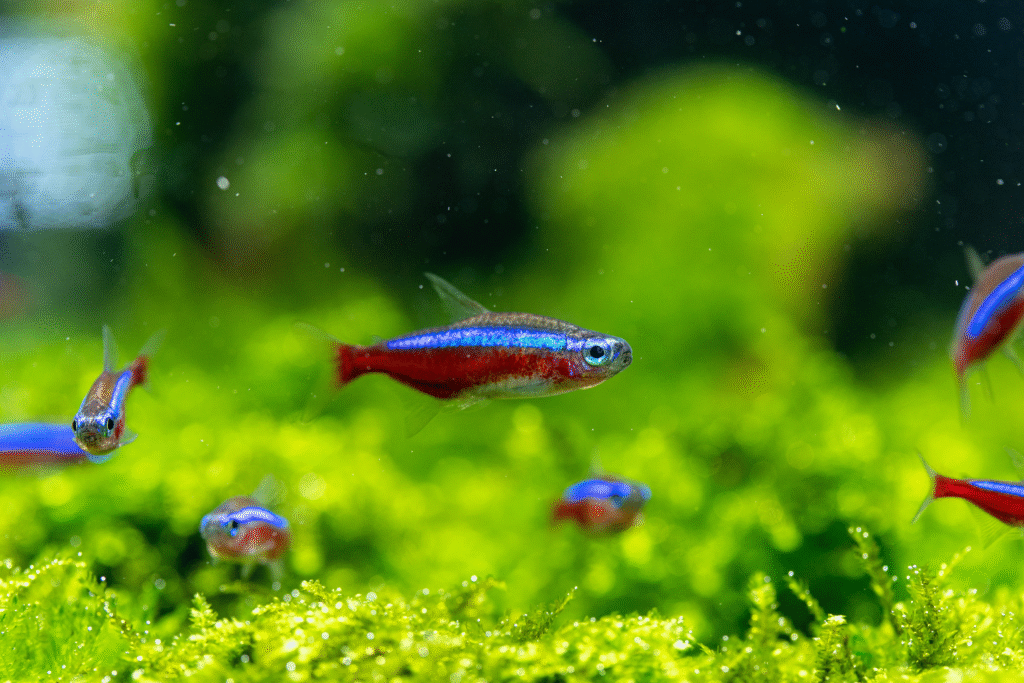
If you’ve ever stood in front of a fish store tank and watched a school of tiny blue-and-red fish flash past like glitter, you’ve met the neon tetra. They’re one of the most popular freshwater fish in the hobby — and also one of the most misunderstood. Half the advice out there treats them like a “beginner fish you can’t kill,” and the other half insists they’re impossibly fragile. The truth sits in the middle, and this guide walks through it: tank setup, feeding, breeding, and why so many people lose their neon tetras in the first few weeks.
Neon Tetra Care Sheet (Quick Reference)
| Parameter | Information |
| Scientific name | Paracheirodon innesi |
| Adult size | 1.2–1.6 in (3–4 cm) |
| Lifespan (aquarium) | Commonly cited around 2–5 years; individual results vary a lot with genetics, sourcing, and care |
| Water temperature | 70–79°F (21–26°C) |
| pH | 6.0–7.0 (tolerates roughly 5.0–7.5) |
| Hardness (GH) | 1–12 dGH |
| Minimum group size | 6, ideally 8–12+ |
| Minimum tank size | 10 gallons; 20-gallon long recommended for a larger school |
| Diet | Omnivore — micro pellets, flakes, live/frozen brine shrimp and daphnia |
| Breeding difficulty | Advanced |
| Heater required | In most homes, yes |
What Is a Neon Tetra? A Quick Snapshot
The neon tetra (Paracheirodon innesi) is a small freshwater fish from the Amazon basin — specifically the clearwater and blackwater streams of Peru, Colombia, and Brazil, as detailed in Seriously Fish’s species profile. It’s one of the most popular aquarium fish in the world, according to FishBase, and is bred commercially at scale for the aquarium trade — enough that University of Florida researchers have studied how to make that farming more efficient.
They’re not endangered or protected — FishBase currently lists the species as IUCN “Least Concern,” largely thanks to their wide natural range.
Neon Tetra Size and Lifespan: What to Actually Expect
How Big Do Neon Tetras Get?
A fully grown neon tetra reaches roughly 1.2 to 1.6 inches (3–4 cm) in length, depending on whether a source measures standard length or total length. They stay small their entire lives, which is exactly why they’re so easy to overcrowd — it’s tempting to cram “just a few more” into a tank when each fish is barely the size of your fingernail.
Neon Tetra Lifespan: How Long Do Neon Tetras Live?
This is a spot where care guides tend to overstate what’s actually known. Lifespan figures for this species vary quite a bit from source to source — you’ll see aquarium references citing anywhere from about 2 to 5 years in captivity, occasionally longer, and figures for wild populations that go as high as 8–10 years. None of these numbers come from rigorous population studies, so it’s more honest to treat them as commonly-repeated estimates than as a guarantee for any individual fish.
What’s more consistently agreed on is why neons vary so much in how long they live: genetics and sourcing, disease exposure, diet, and water quality all play a role, and poor water quality in particular is something you have direct control over. Fish that experience frequent ammonia or nitrite spikes, wide temperature swings, or long stretches without water changes tend to decline early — often from stress-related illness rather than simple old age.
Neon Tetra Fish Tank Setup and Water Parameters
What Water Temperature Do Neon Tetras Need?
Neon tetras are tropical fish and need consistently warm water, generally cited in the 70–79°F (21–26°C) range. Sudden temperature swings are more dangerous than a temperature that sits a degree or two outside the ideal range, since rapid changes stress their immune system and open the door to illnesses like ich.
Do Neon Tetras Need a Heater?
In most homes, yes. Unless your house consistently sits within their preferred range year-round, an aquarium heater with a thermostat is the simplest way to keep the water stable. If your aquarium’s room naturally stays warm and steady without a heater, one may not be strictly necessary — but for most keepers, a heater is standard equipment, because a stable 74°F beats a room-temperature tank that drifts between 65°F at night and 78°F during the day.
pH, Hardness, and General Water Quality
Neon tetras come from soft, slightly acidic water, and their commonly cited ideal parameters reflect that:
- pH: roughly 5.0–7.5, with 6.0–7.0 as a practical target
- General hardness (GH): roughly 1–12 dGH (soft to moderately soft)
- Ammonia/Nitrite: 0 ppm, always — neon tetras are notably sensitive to ammonia spikes in new tanks
A common cause of early neon tetra losses is adding a school to a brand-new aquarium before its biological filter has established itself. Rather than judging your tank “ready” by a calendar, test the water and confirm that ammonia and nitrite are both holding at 0 ppm before adding a full school — a tank isn’t necessarily cycled just because a few weeks have passed.
Tank Size and How Many Neon Tetras to Keep Together
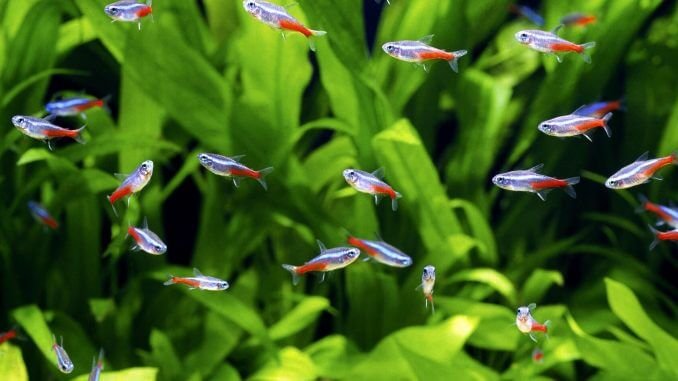
Neon tetras are social shoaling fish and should be kept in groups rather than alone or in pairs — most sources recommend at least 6, ideally 8–12 or more.
A 10-gallon tank is the commonly cited minimum for a small school of 6. A 20-gallon long is an excellent option if you want a larger school — the extra horizontal footprint gives them more room for the fast, darting bursts they naturally use, and dilutes waste more effectively. Rather than relying on a fixed “gallons per fish” formula, prioritize a longer, shallower footprint with good filtration and stocking that matches your maintenance routine — tank shape, filtration capacity, and the other fish sharing the space all matter more than any single ratio.
What Do Neon Tetras Eat? Diet and Feeding Guide
Neon tetras are omnivores. In the wild, they eat small insects, worms, tiny crustaceans, and plant matter, per FishBase’s species record. In captivity, offer a quality staple food along with appropriately sized frozen or live foods for variety.
A solid neon tetra diet includes:
- High-quality micro pellets or flakes formulated for small tropical fish, as a daily base
- Frozen or live baby brine shrimp and daphnia, a couple of times a week
- Bloodworms, occasionally, as part of a varied diet
Feed only what they can finish in about 1–2 minutes, once or twice a day. Neon tetras have tiny mouths, so overfeeding doesn’t just waste food — it fouls the water fast, which circles right back to the water-quality factors that affect their lifespan.
Neon Tetra Breeding: Step-by-Step
Breeding neon tetras is genuinely one of the more advanced projects in freshwater fish-keeping. Most sources describe it as difficult in a standard community tank, which is why the majority of pet-trade neons are farm-raised at commercial scale rather than bred at home, as University of Florida research on the industry has documented. That said, it’s achievable with a dedicated setup.
Setting Up a Breeding Tank
Neon tetras reach sexual maturity around 5–6 months old. To trigger spawning, you need to recreate the soft, acidic conditions of their native streams — considerably softer and more acidic than the average community tank:
- A separate 5–10 gallon breeding tank, dimly lit or covered
- Water temperature around 75–77°F (24–25°C)
- pH lowered to roughly 5.0–6.5, with very low hardness (1–2 dGH)
- Fine-leaved plants or a spawning mop for the female to scatter eggs onto
- Gentle filtration, minimal water movement
Researchers studying captive spawning — including the Chapman et al. and Kucharczyk et al. studies summarized by AquaHoy — have also found that separating males and females for a few weeks beforehand and feeding them well can improve spawning success and egg quality.
Neon Tetra Eggs: What to Expect
Once conditions are right, spawning typically happens around dawn, with the male chasing the female before she scatters her eggs. A female can lay anywhere from roughly 60 to 300 eggs depending on her size and condition.
Neon tetra eggs and newly-hatched fry are extremely light-sensitive — keep the breeding tank in near-total darkness for the first several days, or the eggs may fail to develop. Eggs typically hatch within 24 to 36 hours.
Also worth flagging: remove the adult pair immediately after spawning. Neon tetras will eat their own eggs and fry given the chance.
Raising the Fry
Fry are nearly invisible for the first few days while they absorb their yolk sac. Once free-swimming, start them on infusoria or a liquid fry food, moving up to baby brine shrimp within a week or two. Keep lighting low for the first few weeks; full adult coloration develops gradually over the following couple of months.
Neon Tetra vs. Green Neon Tetra
Not every fish sold as a “neon” is the same species. The green neon tetra (Paracheirodon simulans) is a genuinely different species — smaller than the common neon tetra, with a greener, less blue lateral stripe and much less red on the body. It also comes from true blackwater habitats and prefers slightly warmer, softer, more acidic water than P. innesi, making it a touch more demanding to keep, per FishLaboratory’s green neon tetra care guide.
Why Are Neon Tetras So Hard to Keep Alive?
Neon tetras have a reputation for dying easily, and a lot of that reputation is earned — but usually not for the reasons people assume. Common real causes include:
- Adding them to an uncycled tank. A common cause of early losses is exactly this — their gills are sensitive to ammonia and nitrite, which are exactly the compounds that spike in a brand-new tank.
- Neon Tetra Disease (NTD). A real, species-specific illness caused by the microsporidian parasite Pleistophora hyphessobryconis. According to the Merck Veterinary Manual, it attacks skeletal muscle, and there’s no effective treatment — affected fish are typically removed to limit spread. Importantly, its visible signs — color loss, restlessness, abnormal swimming, a curving spine — aren’t unique to NTD. Stress, poor water quality, and other infections can look similar, so don’t assume every pale or oddly-swimming neon has this specific disease; if multiple fish are affected without an obvious water-quality cause, that’s a good reason to get a professional opinion rather than guess from photos.
- Temperature and pH swings. Because they come from relatively stable natural waters, neons tend to handle sudden change worse than more fluctuation-tolerant species.
- Buying low-quality or stressed stock. Fish that have already been through a rough shipping and holding process arrive with weakened immune systems, making them more vulnerable to disease in the first few weeks at home.
Is a Neon Tetra Easy to Maintain?
It depends what “easy” means to you. Once a tank is properly cycled, stable, and appropriately stocked, neon tetras are genuinely low-maintenance — no special diet, no aggression issues, no complex equipment. Seriously Fish rates their overall care difficulty as easy.
But “easy once it’s set up right” is different from “easy for a total beginner to set up correctly on day one.” Neon tetras can be less forgiving of common beginner mistakes such as adding fish too soon, overstocking a small tank, or allowing temperature and water quality to fluctuate. If you’re new to the hobby, test your water for a couple of weeks after cycling and before adding your school, rather than working from a fixed timeline.
Frequently Asked Questions
How many neon tetras should be together?
At least 6, though 8–12 or more is better for a calmer, more confident school. Fewer than 6 and they tend to hide and show stress-related color loss.
How many neon tetras can I keep in a 10-gallon tank?
A small school of around six is a more conservative starting point for a 10-gallon aquarium, assuming the tank is mature, filtered, and not already heavily stocked. If you want a larger school or additional fish, a 20-gallon long provides substantially more swimming room and stocking flexibility.
Why are my neon tetras losing color?
Persistent color loss can be associated with stress, poor water conditions, or illness, while temporary fading can also occur normally at night as the fish rests. If the fading is one-sided or comes with other symptoms like abnormal swimming, it’s worth having a fish specialist take a look rather than diagnosing it yourself.
Do neon tetras need live plants?
Not strictly, but they help — live plants provide cover that reduces stress, help stabilize water quality, and let the fish display more natural schooling behavior. Floating or dense background plants that dim the lighting tend to suit them especially well.
Can neon tetras live with bettas?
Sometimes, but it’s not a guaranteed pairing. Bettas vary enormously in temperament, and outcomes range from complete indifference to real aggression toward the tetras. If you want to try it, a larger, well-planted tank (20 gallons is a safer starting point than 10) and a full school of at least 6 neons give you the best odds — and it’s worth having a backup tank ready in case it doesn’t work out.
Do neon tetras need a heater?
In most homes, yes — a heater with a thermostat is standard equipment for keeping their preferred temperature range stable.
This guide reflects information current as of 2026 and is intended for general fishkeeping education. Water parameters, lifespan figures, and stocking recommendations vary across sources and can also depend on your specific tank setup and tap water chemistry — when in doubt, test your own water rather than relying on general ranges alone.
Sources & Further Reading
- Seriously Fish — Paracheirodon innesi species profile
- Seriously Fish — Paracheirodon simulans (green neon tetra) species profile
- FishBase — Paracheirodon innesi species summary
- University of Florida — commercial neon tetra breeding research
- Merck Veterinary Manual — Disorders and Diseases of Fish
- AquaHoy — Neon Tetra care, feeding and breeding (summarizes Chapman et al. 1998 and Kucharczyk et al. 2010)
- FishLaboratory — Green Neon Tetra care guide
- Aquarium Science — Neon Disease chapter

Dr. Johnson Coleman is a dedicated veterinary expert with over 10 years of hands-on experience in animal health and wellness. His mission is to help pets live longer, happier lives through compassionate care, practical guidance, and a genuine love for animals.
After earning his Doctor of Veterinary Medicine (DVM) degree, Dr. Coleman spent a decade working in both private clinics and community shelters, where he gained deep expertise in preventive medicine, pet nutrition, and behavioral care.
He believes that pet owners deserve reliable, easy-to-understand information about their companions’ health. Through his writing, Dr. Coleman breaks down complex veterinary topics into friendly, actionable advice that helps readers make informed decisions for their pets.
Outside of his professional work, Dr. Coleman volunteers with local animal rescue groups and enjoys spending time outdoors with his two golden retrievers. His lifelong dedication to animal welfare continues to inspire his work and connect with pet lovers around the world.